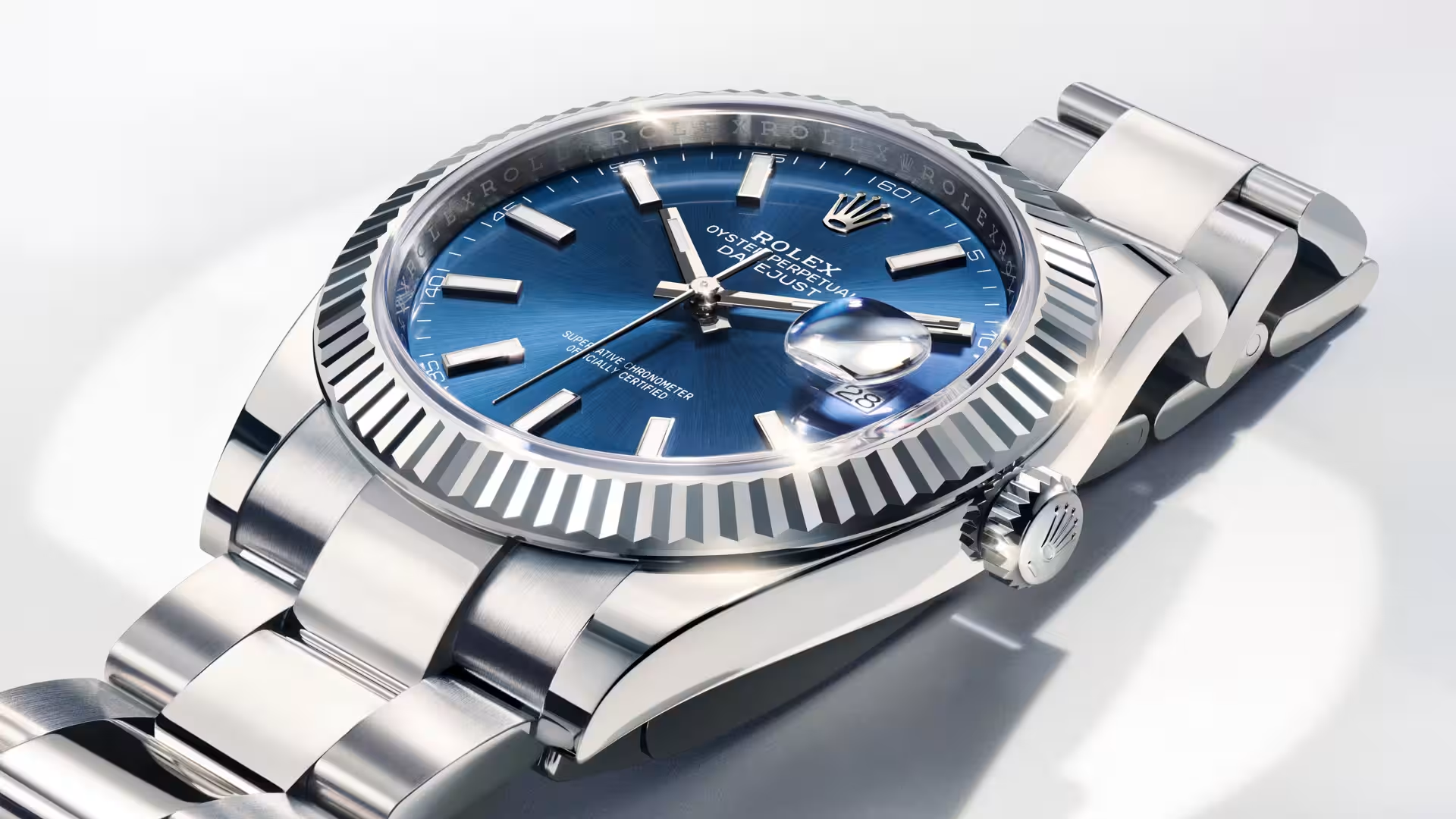
Understanding the provenance of a Rolex timepiece begins with its serial number. This unique identifier not only guarantees authenticity but serves as a timestamp for the era in which the watch was forged.
Interactive Serial Lookup
Enter the serial number found on your watch case or inner bezel to estimate its production year.
How to Locate Your Rolex Serial Number
Rolex has transitioned the location of serial numbers over the decades. Depending on the age of your piece, you will find it in one of three places:
Serial Number
The unique identifier for your specific watch. Used to date the manufacturing year.
Reference Number
Identifies the model type, material, and bezel style. Shared across all identical models.
Post-2008
Modern serials are etched on the inner ring, visible through the crystal at 6 o'clock.
Decoding the Reference Number
While the Serial Number is unique, the Reference (Model) Number tells the watch's story. The first 4-5 digits indicate the collection, while the last two reveal the bezel and material.
- 0: Stainless Steel
- 1: Yellow Tantalum / Everose Rolesor
- 2: Steel & Platinum (Rolesium)
- 3: Steel & 18k Yellow Gold (Rolesor)
- 4: Steel & 18k White Gold (Rolesor)
- 5: Pink Gold / Everose
- 6: Platinum
- 7: 14k Yellow Gold
- 8: 18k Yellow Gold
- 9: 18k White Gold
- 0: Polished / Smooth
- 1: Engine Turned
- 2: Engraved / Engine Turned (Alt)
- 3: Fluted
- 4: Bark Finish
- 5: Pyramid
- 6: Rotating Bezel (Submariner/GMT)
Common Rolex Model Prefixes
| Collection | Reference Prefix |
|---|---|
| Datejust 36 | 162, 1162 |
| Day-Date (President) | 180, 182, 1182 |
| Submariner Date | 166, 1166 |
| GMT Master / II | 167, 1167 |
| Sea-Dweller | 166 |
| Daytona Cosmograph | 1165 |
| Explorer II | 165, 2165 |
The Three Eras of Rolex Serialization
1. The Sequential Era (1926 – 1987)
Originally, Rolex used a simple sequential numbering system. However, in 1954, upon reaching 999,999, the system was reset to 100,000. This is why a serial number in the 100k-900k range can refer to either the early 1950s or the early 1960s.
2. The Letter Prefix Era (1987 – 2010)
In mid-1987, Rolex introduced a letter prefix to indicate the production year. Starting with 'R', followed by 'L', 'E', and 'X' (spelling out ROLEX with 'O' skipped), the system continued through the alphabet until 2010.
3. The Random Era (2010 – Present)
In 2010, Rolex abandoned the predictable year-prefix system in favor of a "scrambled" or random 8-character alphanumeric code. These numbers provide no inherent dating information, requiring a warranty card or original sales receipt to confirm the exact year of sale.
"A serial number is more than a digit; it is the fingerprint of a masterpiece."
Clasp and Bracelet Codes
If your serial number is difficult to read, the bracelet clasp often contains its own date code. Located on the clasp hinge, these 1 or 2 letters correspond to a specific year.
A "period-correct" watch should have a clasp code that roughly matches the serial date; a significant mismatch (over 2 years) may indicate a replacement bracelet or a later service.
Rolex Country Codes: The Regional Database
Every Rolex warranty card contains a 3-digit client code. These provide a window into the watch's origin. For collectors in the Middle East, the **500-series** codes are of primary interest.
Sapphire Crystal Evolution
The transition from Acrylic (Plexiglass) to Sapphire was gradual. Below is the verified timeline for the first implementation across key reference families:
| First Sapphire Reference | Implementation Year |
|---|---|
| Quartz Beta 21 Ref. 5100 | 1970 |
| Sea-Dweller "Triple Six" 16660 | 1978 |
| Day-Date 18038 | 1978 |
| Submariner Date 16800 | 1979 |
| GMT-Master II "Fat Lady" 16760 | 1983 |
| Explorer II 16550 | 1985 |
| Cosmograph Daytona 16520 | 1988 |
| Datejust 36 162xx Series | 1988 |
Expert Collector Tips & Warnings
-
The "Super Clone" Danger
Modern high-end counterfeits feature laser-etched rehauts that can fool a casual observer. Authentic Rolex engravings are "diamond-cut" with sharp, deep lines that reflect light differently than acid-etched fakes.
-
Privacy Matters
Never share your full serial number in public photos. Counterfeiters use real serials to create more convincing fakes, and your authentic watch could be mistakenly flagged in stolen-item databases.
-
Authentication First
Serial charts are estimates. For high-value investments, always seek professional authentication that includes an inspection of the internal movement stamps.