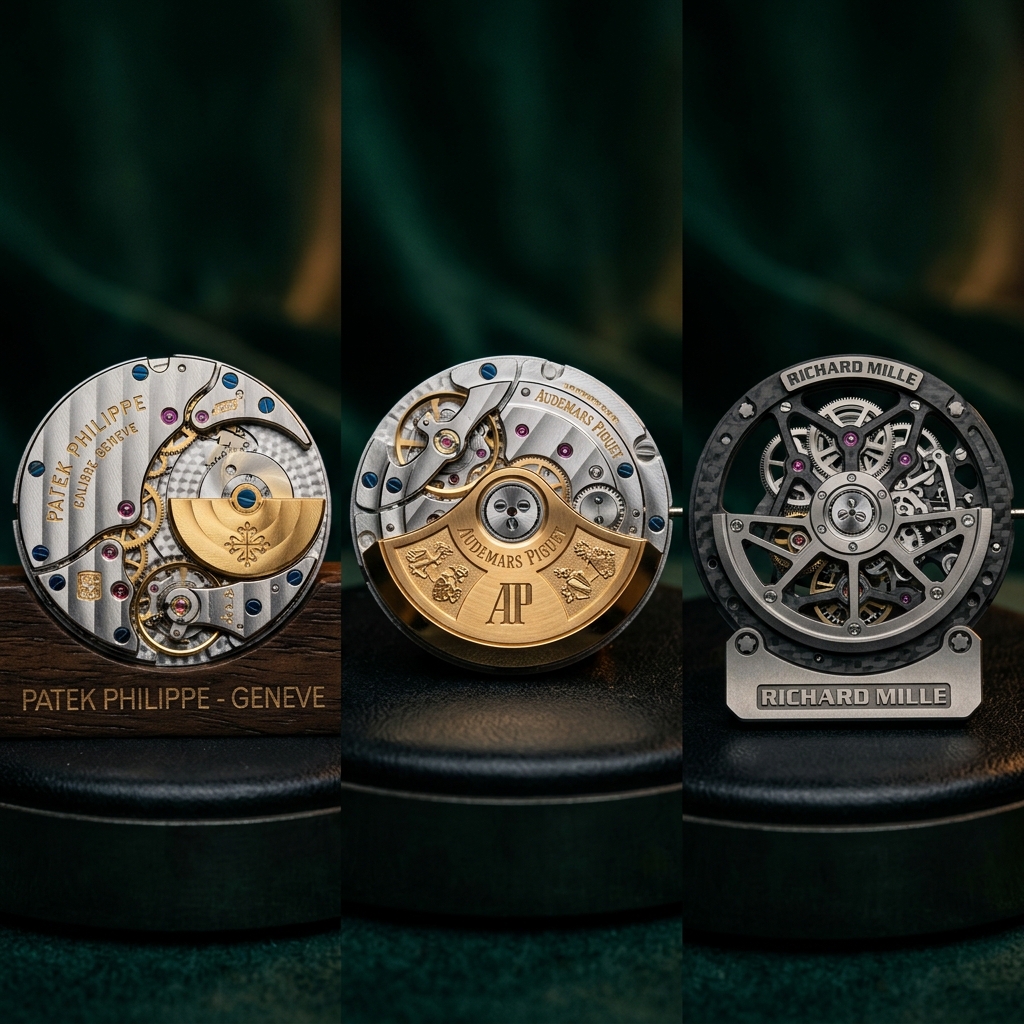
The history of Audemars Piguet is not merely a chronicle of a luxury brand but a record of technical defiance against economic and industrial obsolescence. Founded in 1875 in the village of Le Brassus, within the Vallée de Joux, the manufacture represents a unique continuum of independent, family-owned Swiss watchmaking.
The Founding Partnership and the Établissage Framework
The formalization of the Audemars Piguet partnership in 1881 followed six years of informal collaboration between Jules Louis Audemars and Edward Auguste Piguet. The division of labor was strictly defined by expertise: Audemars oversaw the technical production and engineering of movements, while Piguet managed the commercial and financial strategy.
Early Chronological Milestones
| Period | Event or Metric | Significance |
|---|---|---|
| 1875 | Founding in Le Brassus | The "Trial by Fire" during an industry-wide crisis |
| 1881 | Contract Formalization | Birth of Audemars Piguet & Cie |
| 1882 | Production Start | Records begin with movement No. 2000 |
| 1882–1892 | Acoustic Specialization | Over 50% of the 1,625 watches produced were chiming mechanisms |
| 1910 | Annual Production | 310 watches per year |
| 1930 | Annual Production | 515 watches per year |
The Acoustic Legacy: Engineering the Sound of Time
Audemars Piguet’s historical preeminence in minute repeaters is a direct consequence of the 19th-century requirement for nocturnal time-telling. In 1892, the manufacture achieved a global first by miniaturizing a minute-repeating movement for a wristwatch.
Supersonnerie Innovation
The modern evolution of this acoustic legacy is the Supersonnerie technology, introduced in 2015. Traditional minute repeaters attach the gongs directly to the movement’s mainplate, which acts as a poor resonator. Audemars Piguet reimagined this architecture using a soundboard membrane.
The Pursuit of Thinness: Miniaturization as a Discipline
In the 20th century, Audemars Piguet specialized in ultra-thin movements. In 1921, the manufacture established a world record with a pocket watch movement just 1.32 mm thick.
The Calibre 2120/2121 Engine
The most significant development in ultra-thin automatic movements occurred in 1967 with the birth of the Calibre 2120. This movement was the essential engine for Gérald Genta's 1972 Royal Oak (Ref. 5402), enabling its slim 7 mm case height.
The Evolution of the Perpetual Calendar
In 1955, the manufacture introduced Reference 5516, the first perpetual calendar wristwatch to include a leap year indication. The pinnacle of this evolution arrived in 2018 with the Royal Oak RD#2. The Calibre 5133 within this watch measures just 2.89 mm thick.
Chronograph Engineering: Integrated In-House
In 2019, Audemars Piguet introduced the Calibre 4401 in the Code 11.59 collection, marking a definitive shift to a fully in-house integrated flyback chronograph. This movement was designed with a column wheel and vertical clutch system, which prevents the chronograph hand from "jumping" when the pusher is engaged.
The RD Series: Pushing the Envelope
The RD series at Audemars Piguet acts as a high-horology laboratory. RD#4 (2023) is the manufacture's first ultra-complicated automatic wristwatch, incorporating 40 functions, including 23 complications and 17 technical devices.
Conclusion: The Integrated Vision of Le Brassus
The horological evolution of Audemars Piguet movements is characterized by a paradox: the manufacture is deeply committed to ancestral traditions while simultaneously acting as an industry disruptor through material science and unconventional geometry.