The history of Rolex movement manufacturing is a study in industrial foresight, mechanical refinement, and the relentless pursuit of vertical integration. Unlike many of its contemporaries that relied on established movement houses for decades, Rolex embarked on a specific trajectory that transitioned from strategic partnerships to the eventual total control of its movement production. This evolution is characterized not merely by the aesthetics of horology, but by the functional requirements of precision, robustness, and ease of service.
The trajectory from the early Aegler calibres to the contemporary 32xx series and the groundbreaking Land-Dweller movements of 2025 reveals a consistent philosophy: the movement is the silent, efficient heart of a tool designed to operate under any environmental extreme.
The Foundations of the Bienne-Geneva Diarchy
The structural origins of Rolex movements are found in the unique relationship between the Wilsdorf/Davis partnership and the Aegler/Borer family. It is a common misconception that Rolex was always a fully integrated manufacture. In reality, the company that produced movements for Rolex, Aegler S.A., remained a separate legal entity from the Geneva-based Rolex S.A. until as recently as 2004. This dual-entity system, often referred to as "Rolex Bienne" and "Rolex Genève," defined the brand’s technical capacity for a century.
The Aegler Legacy and the 1905 Genesis
When Hans Wilsdorf founded his watch distribution company in London in 1905, the wristwatch was largely a novelty, often dismissed as an inaccurate accessory for women. Wilsdorf’s core challenge was to find a movement small enough to fit a wrist-bound case but precise enough to meet chronometer standards. He turned to the Jean Aegler workshop in Bienne, which had specialized in small, high-quality mechanical movements since its founding in 1881. Jean Aegler’s widow, Anna Maria, and her sons Hermann and Hans, had maintained the facility’s reputation for miniaturization.
Wilsdorf’s vision was cemented in 1908 when he negotiated the largest contract for watch movements signed at the time, ensuring that Aegler would provide a consistent supply of precision calibres for the newly trademarked "Rolex" brand. This partnership was so critical to Wilsdorf’s success that after the company relocated its operations from London to Geneva in 1919, Hermann Aegler became a board member of Rolex.
The Bienne facility eventually operated under the name "Manufacture des Montres Rolex S.A.," yet it remained wholly owned by the Aegler and Borer families until its eventual acquisition by the Rolex parent company under the leadership of Patrick Heiniger in 2004 for a reported CHF 1 billion.
| Era | Primary Manufacturing Status | Key Leadership |
|---|---|---|
| 1881–1905 | Aegler independently established in Bienne | Jean Aegler, Anna Maria Aegler |
| 1905–1919 | Early partnership; movements imported to London | Hans Wilsdorf, Hermann Aegler |
| 1919–2004 | Formal diarchy (Rolex Bienne vs. Rolex Genève) | Emile Borer (Technical Director), Harry Borer |
| 2004–Present | Fully vertically integrated manufacture | Rolex SA (Geneva/Bienne combined) |
Early Milestones in Precision
The quest for chronometric validation was the primary tool Wilsdorf used to convince the public of the wristwatch’s viability. In 1910, a Rolex movement manufactured in Bienne became the first in the world to receive a Swiss Certificate of Chronometric Precision from the School of Horology. This was followed in 1914 by the awarding of a "Class A Certificate of Precision" from the Kew Observatory in England. This was a transformative moment for the industry, as such certificates were previously granted only to marine chronometers used for naval navigation.
The Perpetual Revolution: The 360-Degree Rotor
The most enduring contribution Rolex has made to horology is the development of the "Perpetual" automatic winding mechanism. While self-winding watches had been conceptualized as early as the 18th century, they were notoriously fragile and inefficient when adapted to the wrist.
The Limitation of the Bumper Movement
By the early 1920s, the "bumper" or "hammer" automatic movement was the standard for self-winding wristwatches, largely based on the patents of John Harwood. In a bumper movement, the oscillating weight did not rotate freely. Instead, it traveled through a limited arc—typically between 200 and 270 degrees—and was stopped by spring-loaded buffers at each end. Technically, the bumper system suffered from three significant flaws:
- The energy was only transmitted to the mainspring in one direction of the weight’s travel (unidirectional winding).
- The "bump" itself applied repeated mechanical shock to the movement’s pivots, increasing wear over time.
- Much of the kinetic energy was lost in the dampening process.
The 1931 Perpetual Patent (CH158017)
In 1931, Emile Borer, technical director at Aegler and nephew of Hermann Aegler, patented the first commercially viable 360-degree rotor system (Patent No. CH158017). The "Perpetual" rotor allowed the weighted mass to spin freely in both directions around a central axis. Although early iterations still wound in only one direction, the efficiency gained by capturing energy through a full rotation was vastly superior to the bumper system.
The impact of this patent cannot be overstated. It effectively locked out the rest of the Swiss watch industry from using a 360-degree rotor until the patent expired in 1948. During this nearly two-decade period, other major manufactures like Omega, Jaeger-LeCoultre, and Zenith were forced to continue using the inferior bumper technology, allowing Rolex to dominate the market with the "Oyster Perpetual" line.
| Technology | Rotation Arc | Winding Type | Drawbacks |
|---|---|---|---|
| Bumper (Harwood) | 200°–270° | Unidirectional | Shock to pivots, energy loss |
| Perpetual (Borer) | 360° Full Rotation | Unidirectional (Early) | Thicker movement profile |
| Bidynator (Felsa) | 360° Full Rotation | Bidirectional | Patented after Rolex |
The Workhorse Era: Development of the 1500 and 3135 Families
Following the success of the early Oyster Perpetual calibres, Rolex transitioned into an era of industrial refinement. The goal moved away from inventing new categories of watches and toward perfecting the "workhorse" movement—a calibre that could survive extreme conditions while maintaining chronometric accuracy.
The 1030 and the Butterfly Rotor
The introduction of the Calibre 1030 in 1950 marked a turning point, as it was the first "fully in-house" calibre produced under the consolidated Rolex/Aegler technical standards. It was a bidirectional automatic movement characterized by its "butterfly rotor"—a weighted mass with significant cut-outs designed to reduce inertia while maintaining enough mass to effectively wind the mainspring.
The 1500 Series: The Industrial Mainstay
In 1957, Rolex launched the 1500 series, including the legendary calibres 1570 and 1575. These movements are widely regarded by watchmakers as some of the most robust ever manufactured. They featured a frequency of 19,800 vph and introduced the Microstella regulation system, which remains a hallmark of Rolex precision. The 1500 series proved so reliable that it remained in production for over 20 years.
The 3135 Era: 1988–2015
For nearly three decades, the Calibre 3135 served as the "backbone" of the Rolex catalog. Introduced in 1988, it refined the 3035 architecture by replacing the single-sided balance cock with a full balance bridge fixed at both ends. This structural change significantly improved the stability and shock resistance of the oscillator.
| Calibre | Year | Frequency | Jewels | Key Innovation |
|---|---|---|---|---|
| 1030 | 1950 | 18,000 vph | 25 | Bidirectional "Butterfly" Rotor |
| 1570 | 1957 | 19,800 vph | 26 | Microstella Regulation |
| 3035 | 1977 | 28,800 vph | 27 | High-beat frequency, Quickset date |
| 3135 | 1988 | 28,800 vph | 31 | Full balance bridge, stability |
Material Science and Patented Technologies
Beginning in the late 1990s, Rolex shifted its R&D focus toward material science, aiming to overcome the inherent physical limitations of traditional horological metals. These innovations were designed to combat magnetism, temperature fluctuations, and kinetic shock.
- Parachrom Bleu Hairspring: Introduced in 2000, made from a paramagnetic alloy of niobium and zirconium. It is up to 10 times more resistant to shocks than traditional springs.
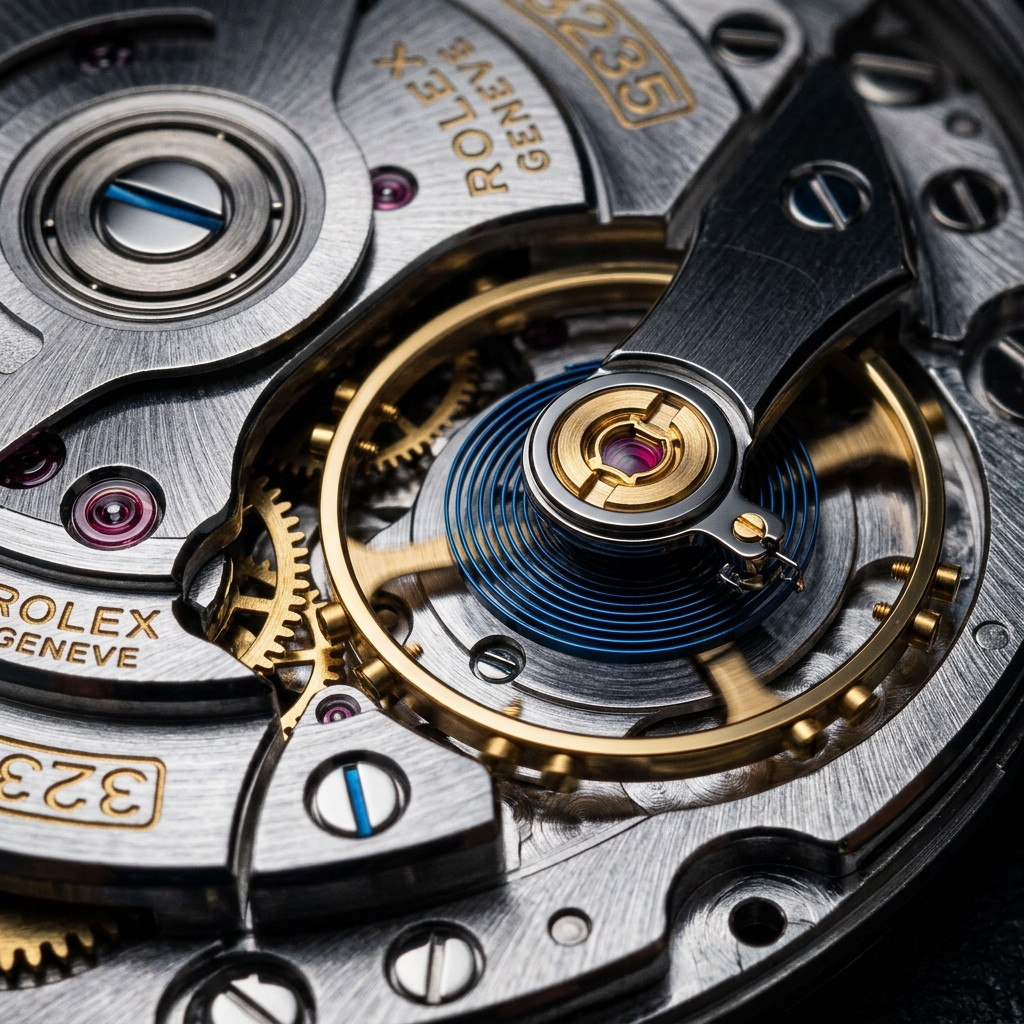
- Syloxi Hairspring: Introduced in 2014, crafted from silicon with a patented geometry that improves isochronism by ensuring perfectly concentric expansion and contraction.
- Paraflex Shock Absorber: Developed in 2005, this system improves shock resistance by up to 50% using 3D dynamic modeling to disperse kinetic energy.
The Modern Generation: Chronergy and the 32xx Series
Introduced in 2015, the 32xx series represents the current pinnacle of Rolex movement engineering. The most critical innovation is the Chronergy escapement. Rolex re-engineered the geometry of the pallet fork and the escape wheel to optimize energy transfer, resulting in a 15% increase in mechanical efficiency.
This efficiency, combined with a new thinner-walled barrel design, allowed Rolex to increase the power reserve from 48 hours to 70 hours—making the movements "weekend-proof."
Future Horizons: The Dynapulse Escapement (2025)
As Rolex enters the mid-2020s, it has unveiled the Calibre 7135 featuring the new "Dynapulse" escapement. Operating at a high frequency of 5 Hz (36,000 vph), it allows for even greater precision. The movement also introduces a ceramic balance staff, virtually immune to high-intensity magnetic fields.
The Superlative Chronometer Standard
In 2015, Rolex introduced a new internal certification process applied to 100% of its watches after casing. The Rolex "Superlative Chronometer" standard permits a deviation of only -2 / +2 seconds per day—more than twice as strict as the COSC requirement.
| Testing Criteria | COSC Standard | Rolex Superlative Standard |
|---|---|---|
| Precision (Daily Rate) | -4 / +6 sec/day | -2 / +2 sec/day |
| Testing State | Uncased Movement | Fully Assembled Watch |
| Positions | 5 Static Positions | 7 Static + Rotating Rack |
The history of Rolex movements is a linear progression toward a single goal: the creation of a maintenance-free, ultra-accurate mechanical instrument. By mastering material science and re-engineering fundamental horological geometries, Rolex has secured the future of the mechanical watch in a digital age.